Between Model and Architecture
Anna Moldenhauer: Your work features fragments of urban landscapes. What factors do you consider when selecting them?
Amelie Plümpe: We both incorporate architectural fragments and forms that inspire us and that we encounter in our everyday lives. There’s no set process; it’s a playful and intuitive selection. It’s only during the later translation phase that something resembling a set of rules emerges, such as ensuring that the elements can be carried. However, there are no guidelines on which forms must be incorporated. Furthermore, we never adopt these architectural elements exactly as they are. We either add our own aspects or simplify them.
At your exhibition this year at the House of Galleries in Frankfurt am Main, I saw people stopping to look at your art, looking confused or surprised. They thought they recognised a familiar shape, only to discover on closer inspection that the paint bucket was ceramic or the ventilation shaft was MDF. You strip the supposedly familiar design of its function. Why does this contrast fascinate you?
Alice Hauck: In an industrial context, much is shaped by standards, regulations, and functional requirements. We are interested in these logics because they produce forms that are not primarily the result of design decisions, but of usage, efficiency and technical constraints. Our work operates precisely at the intersection of model and architecture: we adopt such functional forms and reinterpret them.
Amelie Plümpe: What interests me most about this contrast is the shift in perception. I hope that viewers will compare the real world with our artworks. We hardly notice many objects and architectural features in the urban landscape anymore because we have become so accustomed to them. Many of these elements can be found in our modular sculptural system. By constantly adding modules, we can build ever larger landscapes. When we realise a particular component is missing, we create it. Alice and I share a fascination with certain elements of the urban landscape. I like to call it a kleptomaniacal feeling towards the urban landscape. We want to make these parts our own by treating them as sculptures and possessing them.
Could you explain why you feel the need to take fragments of the city?
Alice Hauck: The city is essentially a public space, like a vast playground. However, it is becoming increasingly inaccessible due to fences, doorbells and privatisation. Perhaps our work is also an attempt to reclaim a part of this world, which is currently undergoing profound change. We live and work in Berlin and experience these developments first-hand. We are also interested in preserving objects and micro-architectures that are gradually disappearing from the urban landscape.
This also raises the question: Who does the city belong to?
Alice Hauck: Exactly. Perhaps a childlike impulse is also at play here – the feeling we had in our youth when we used to climb onto rooftops without a care because they were freely accessible. Nowadays, so much is locked away. In a way, it's about reclaiming such spaces. At the same time, I’m interested in how rules and norms influence the design and organisation of spaces. Who sets these rules, and who is free to move within them? The city is often considered a public space, yet it is also heavily regulated and structured. This is why I find questions of access, use, and decision-making power so fascinating.
How do you decide which scale to use for an object?
Alice Hauck: Scale is central to our work. Of course, many industrial elements adhere to specific standards or DIN dimensions. While we sometimes use these as a guide, we’ve realised that these measurement systems aren’t always practical for our work or bodies. That’s why we often work with our own scales, based on our own body measurements. Many of our modules are precisely tailored to this. A lot depends on the weight we can lift and move ourselves. If we want to build something larger than our own body dimensions allow, we design it so that we can assemble it from several modules to create a larger structure. Handle heights are important here, as are the dimensions with which we feel comfortable.
Amelie Plümpe: It is also a sculptural choice.' The sculptures are too small to be considered functional architecture, yet too large to be seen merely as models. In most cases, the forms are smaller than the original architectural structures, which can disorientate the viewer's perception of space when they encounter the installation.
Alice Hauck: At the same time, we are becoming more and more interested in forms drawn from logistics and infrastructure. However, depicting this architecture to scale would require a great deal of space, which is not our intention. That is why we work with reduced scales. Consequently, our work often straddles the line between model and architecture, and sometimes these scales blend together.
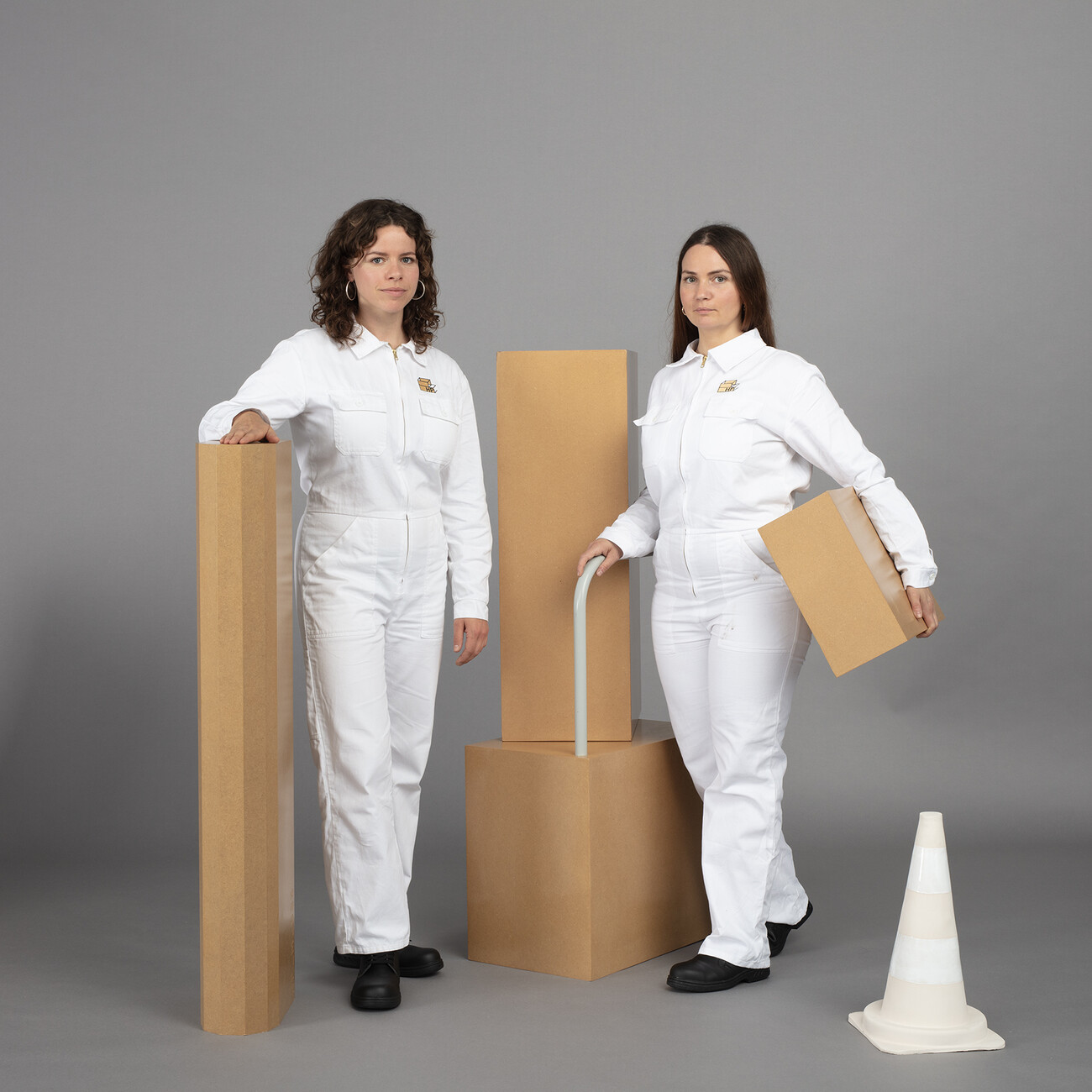
From your name to the overalls you wear during performances, your modular system, the numbering of your works and the design of your catalogue, all these elements strongly evoke industry. What interests you about this connection?
Amelie Plümpe: As we started working on a large scale from the outset, it soon became apparent that all the aspects surrounding the exhibition, such as storage, handling and the physical effort involved, are just as important as the exhibition itself. These operational aspects have become a second pillar of our work. They reflect logistics, production and the art world. This is also evident in our catalogues, where we reveal these invisible processes.
Alice Hauck: We’ve realised that we’re not just artists; we also run a small business with a warehouse, production facilities, an office, and we have to do tax returns. At some point, we recognised these organisational structures as an integral part of our work. Many industrial systems operate in exactly the same way, through logistics, archiving, numbering and processes. We’re very interested in these organisational forms because they usually remain hidden. In our work, we try to make these invisible processes visible, too. During residencies, we have also begun to examine other professional systems, such as those at the Torhaus and in underground stations. We explored how shift systems work and where people take their breaks. The modules subsequently became almost like stage sets. In one video piece, for instance, we had a performer act out a scene in our factory.
Routines and habits are a key feature of your work, which I find particularly striking. What role do these play for you?
Alice Hauck: That’s a good point.
Amelie Plümpe: For me, routines primarily play a role in our conceptual work and collaboration rather than in the sculptures themselves. For me, routine means archiving things, for example. This helps us develop a shared system over the long term. Sometimes we work in sequences, and sometimes one of us introduces specific modules. Then, of course, there are the routines of other professions, which we have explored in our more recent works.
Alice Hauck: When we exhibited our work in a glass display case at Berlin’s Alt-Mariendorf underground station, it became clear to us just how much a city relies on routines. The underground runs on a regular schedule, and if it breaks down, many things immediately fall out of balance. A city functions through recurring processes, much like a heartbeat. We often perceive routines as boring or tedious, especially when everyday life seems monotonous. Yet we are constantly surrounded by them – whether it be bank transfers, road traffic or organisational processes. We often only notice this when we consciously engage with it. We are also interested in the routines of other professions. Our work explores processes that normally take place in the background, such as logistical procedures or organisational structures. These recurring actions shape the everyday life of cities, workplaces and infrastructure. Yet they often remain invisible.
Amelie Plümpe: Routines actually give me a sense of stability. We’re a GbR, which is a type of small business. This helps me to maintain my role as a freelance artist and establish certain structures. It strikes a balance between playfulness and organisational reality.
Alice Hauck: That’s true; having a routine can be reassuring. It brings structure to everyday life while still allowing for artistic freedom. However, it can be challenging to establish and maintain routines when you’re self-employed.
Amelie Plümpe: Much of what female artists do remains unseen, including everything that happens alongside the actual exhibition. A large part of their work involves organisation, communication and administration. This unseen work is always part of the bigger picture.
What is the reason behind your desire to make these processes, which are invisible to the naked eye, visible?
Alice Hauck: It makes me angry when this work goes unnoticed or isn't discussed. Things just work, but the people behind them are invisible. That’s what drives me.
Amelie Plümpe: For us, this need also arises from working together.' Many aspects of life in the studio, such as the way we interact, our clothing and our routines, take on an almost performative quality. The conceptual focus only emerged later. I feel that the roots lie in our working environment and have developed over time. Meanwhile, our approach is becoming increasingly political.
Do you work with 3D models, do you sketch, or do you go straight into the space?
Amelie Plümpe: Actually, everything you’ve listed. Depending on the project's size and scope, we either build full-scale mock-ups in the space or create sketches or 3D models. However, a 3D model can never quite match an analogue, tactile model. For me, the physical process of building and working with scale and materials in the model is very important for developing the sculptures.
Alice Hauck: We have to experiment with a lot of things in the space itself because our work is closely linked to body dimensions, movement, and passageways. To achieve this, we often construct basic cardboard models to test the dimensions of different shapes. I remember our cellar hatch, for example. We built several cardboard mock-ups of it to work out how tall it needed to be to allow us to crawl through easily and comfortably. Such tests are only of limited use in a digital model — you only realise how something really feels when you’re in the space. A lot of it emerges directly from working together. I particularly like those moments when we think and make decisions through dialogue while building.
Amelie Plümpe: We can only design things on our own up to a certain point. It is only when we come together and work in the space that the actual design takes shape.
You are described as sculptors, as artists, as architects of space. Is there a term you prefer?
Amelie Plümpe: We are artists.
Alice Hauck: I feel exactly the same way! I think this artistic duo brings out many different facets of who we are. You don’t always see that straight away, but because we’re constantly rearranging our work in the studio and moving around the space, I also see us as performers. We're performers who build our own stages.
You studied under Carsten Konrad at the Berlin University of the Arts. He creates architecture-related works using everyday found objects. Which aspects of his approach have you incorporated into your own practice, either from his teaching or from your experience of studying at the university?
Amelie Plümpe: Naturally, you gain a lot from an art degree, especially if, like us, you have had the privilege of using large workshops and your own studio. These resources were unavailable to us immediately after graduating, which presented a major challenge. We needed wood, ceramics and metal workshops, as well as mould-making facilities – in other words, spaces that require significant infrastructure. We had to build these up bit by bit, for example through the Federal Association of Visual Artists and the sculpture workshops in Berlin.
Alice Hauck: For me, it’s something fundamental: courage. The courage to try things out, to believe in yourself, to think big. Before I started my degree, I couldn’t have imagined working on such a scale. The attitude of ‘We need a saw, so let’s get one’ also stems from that time. I’ve definitely taken with me that sense of self-assurance that you’re allowed to learn, test and work things out for yourself.
Amelie Plümpe: Another matter to consider is the significant autonomy we have in our profession. Compared to other universities, at least. As far as I can tell, at the UdK, students had to learn early on to organise themselves and develop independence in their working process. It's the opposite of a strictly structured degree programme.
Alice Hauck: The freedom to try things out is precisely what encourages people to be brave.
What are you working on at the moment?
Amelie Plümpe: Our next major exhibition opens on 12 June 2026 at our Frankfurt branch. This will be our second solo exhibition there. Without giving too much away, it will once again focus heavily on industrial spaces and the people who move within them.'
You founded Hauck Plümpe in 2018 – looking back, how has your work developed?
Alice Hauck: For me, everything emerges from the process itself. No piece of work stands alone; they all develop organically. In my mind, it’s a fluid progression in which one piece builds on another. Sometimes new concepts or themes emerge that we want to explore further, such as with our film work. I hope it continues to evolve organically.
Amelie Plümpe: I don't think setting a specific, fixed goal would do the work any favours either. Much of it stems from the issues we still want to address, such as themes that interest us or unresolved matters. But there’s no fixed roadmap. It depends heavily on the exhibition setting, such as whether it’s a gallery or an art association, how much space we have and how playfully we can work. All of that influences the development.
Tip:
Hauck Plümpe @ Galerie Filiale
13 June to 18 July 2026
Opening on 12 June
Stiftstrasse 9
60313 Frankfurt am Main, Germany
Opening hours:
Tue to Fri 2 pm – 6 pm
Sat 11 am – 3 pm