Heaven and Hell
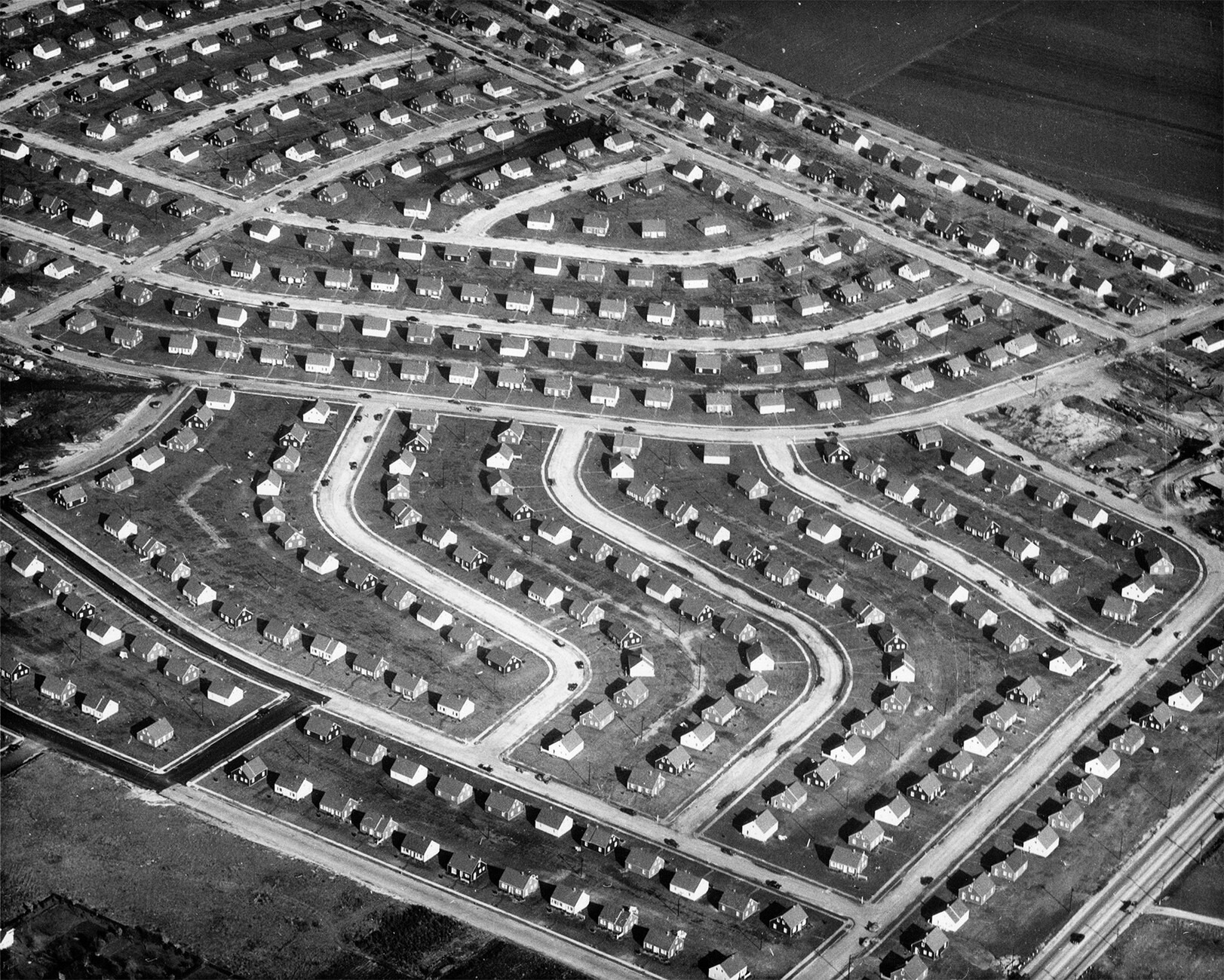
Peter Piller’s series, “Lawn Mowing”, does not disappoint. We are given a bird's-eye view of detached houses from the 1970s and 1980s, with a patch of grass in their gardens currently being tended. The photographs were once used to advertise the houses for sale. The artist’s series now highlights the synchronised routines of suburban residents and the minute details of supposedly idyllic homes, the aesthetics of which conceal a social compulsion towards homogenisation. The Deutsches Architekturmuseum is currently presenting an interdisciplinary exhibition called 'Suburbia', running until 18 October 2026. It sheds light on the 'perfect world' façade and the social phenomena associated with it, from the emergence of the single-family home boom during the years of the German economic miracle, to artistic positions that address the realities of US suburbs. Examples include the grotesque mix of architectural styles in the ostentatious yet poorly constructed, mass-produced detached houses of so-called 'McMansion' architecture. Another example is the large housing estate “Levittown”, a planned community utopia that emerged on Long Island in 1947 after the Second World War through the mass production of identical floor plans using prefabricated components, primarily for the white middle class and returning soldiers. Levittown, developed by Levitt & Sons, became the prototype of the uniform American suburb, as well as a symbol of racial segregation in the United States.
In post-war Germany, the magazine Schöner Wohnen ("Better Dwelling") successfully presented the dream of an ideal world as something within reach to the general public. The first issue was published in 1960, and many volumes are on display in the exhibition. The conservative ideal is explored through home stories, advice columns, and depictions of consumer culture. Similarly, clips from 1990s sitcoms such as "Hör mal wer da hämmert" ("Home Improvement") and sequences from home videos depicting picture-perfect everyday life in a detached house demonstrate the strong reflection of the collective aspiration for life in private property and DIY self-empowerment in our media socialisation.
Flawless Abyss
The extent to which politics influenced the development of private space is evident from the heteronormative and patriarchal family stereotypes that have been highlighted, which were associated with the concept of home ownership. Following the horrors of violent conflict, the federal government promoted home ownership as a goal for a successful life in peacetime, much like private pension provision. This narrative was opposed to collective forms of housing and ownership and was state-subsidised through building society savings schemes. The idea was that if people tended to a house and garden, they would not start a war. However, this spatial order manifested structural sexism: the man is the breadwinner and makes all the major decisions. The woman is expected to run the household, be a mother and carry out unpaid care work cheerfully and tirelessly. She could only leave the suburbs if she had access to a car or a lift. This discrimination led to the emergence of the second wave of feminism in the 1960s. A lasting slogan coined in 1969 by the American feminist Carol Hanisch was “The personal is political”. In Germany, the legal obligation for women to run the household was abolished in 1977 as part of the marriage and family law reform, with further changes following. Despite the legal equality that has been achieved so far, systematic discrimination against women compared to men remains widespread in our society to this day.
Through media home stories, politicians showcased to the public just how convinced they were of the lifestyle they were promoting for the domestic sphere. In 1960, Ludwig Erhard, who was then Federal Minister for Economic Affairs and would subsequently become the second Chancellor of the Federal Republic of Germany, was photographed by Schöner Wohnen at his house on Lake Tegernsee for an article titled “Homeowner Professor Ludwig Erhard”. Helmut Kohl, the sixth chancellor of the Federal Republic of Germany, staged his family idyll in Oggersheim and at his holiday home in St Gilgen on Lake Wolfgang for decades, with great media success.
Transforming your home
Spread across four sections, the ‘Suburbia’ exhibition takes visitors on a journey through the origins and planning of the American Dream, including the development of infrastructure as part of urbanisation, and on to the suburban boom and the post-suburban era. Through digital distortion, the artist Weronika Gęsicka highlights the paradox of clichéd scenes from the 'American Way of Life' of the 1940s to the 1960s: by altering details, the fragments take on a surreal character. This disruption to images that we think we know challenges our visual habits regarding the suburban dream. The narrative then leads to a housing nightmare, with Gabriele Galimberti's photographs in 'The Ameriguns' powerfully demonstrating how property ownership can maximise fear of evil. This fear must be combatted by any means possible, such as through extensive weapon collections, which are proudly displayed by owners inside and outside their homes. Likewise, the abysses that can open up behind closed doors become visible. Angela Strassheim, a former forensic investigator, has captured scenes of domestic, patriarchal violence in her series of photographs, “The Evidence”. With a matter-of-fact gaze, she explores suburban house façades as well as crime scenes in rooms believed to be safe havens. A recent press release from the Federal Criminal Police Office shows just how relevant the subject of this series, created from 2007 onwards, remains. In 2024, 265,942 people in Germany were victims of domestic violence, setting a new record high. At 70.4 per cent, the majority of victims were female. Her series 'Left Behind' also addresses the themes of family and female identity within the constraints of rigid orthodoxy.
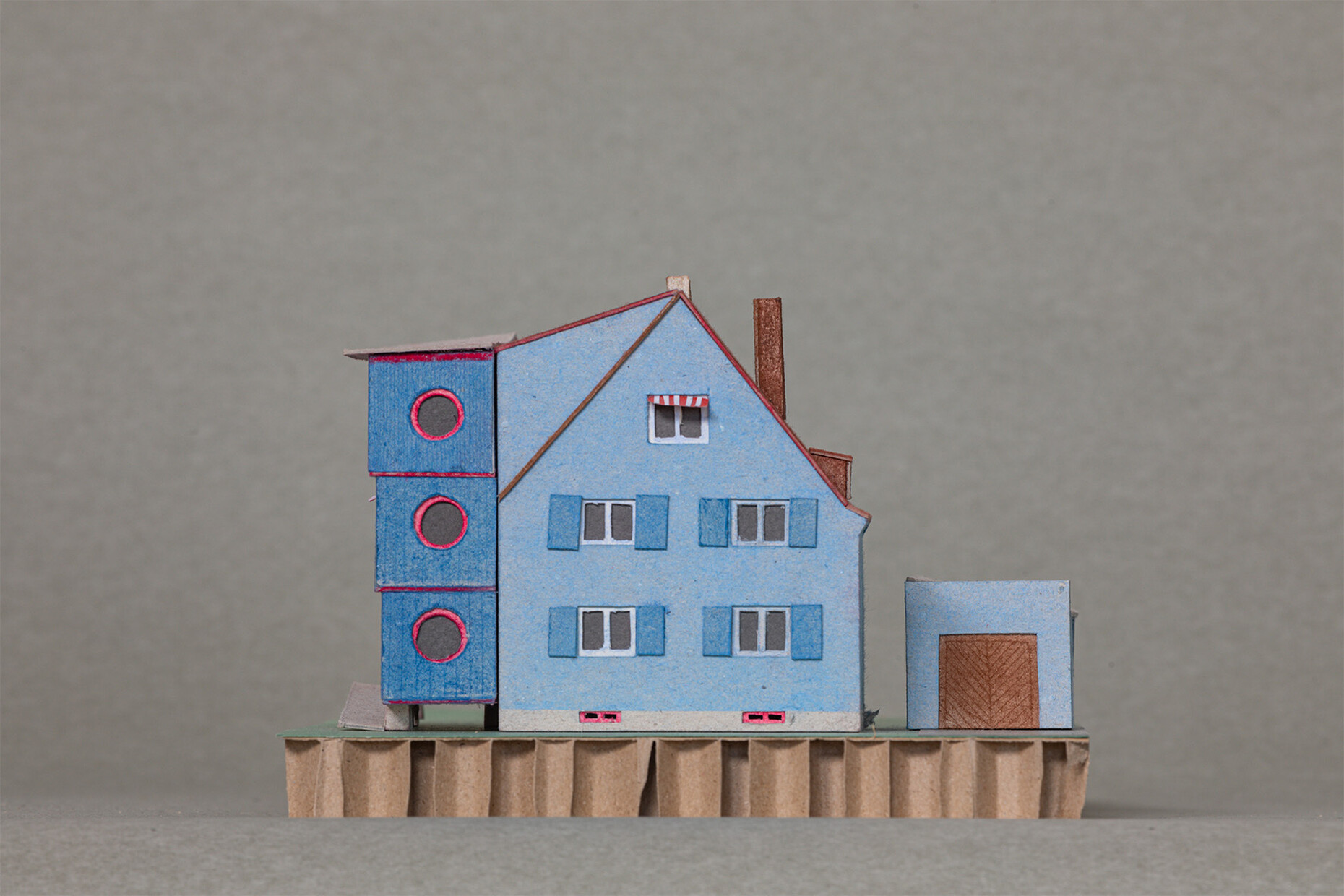
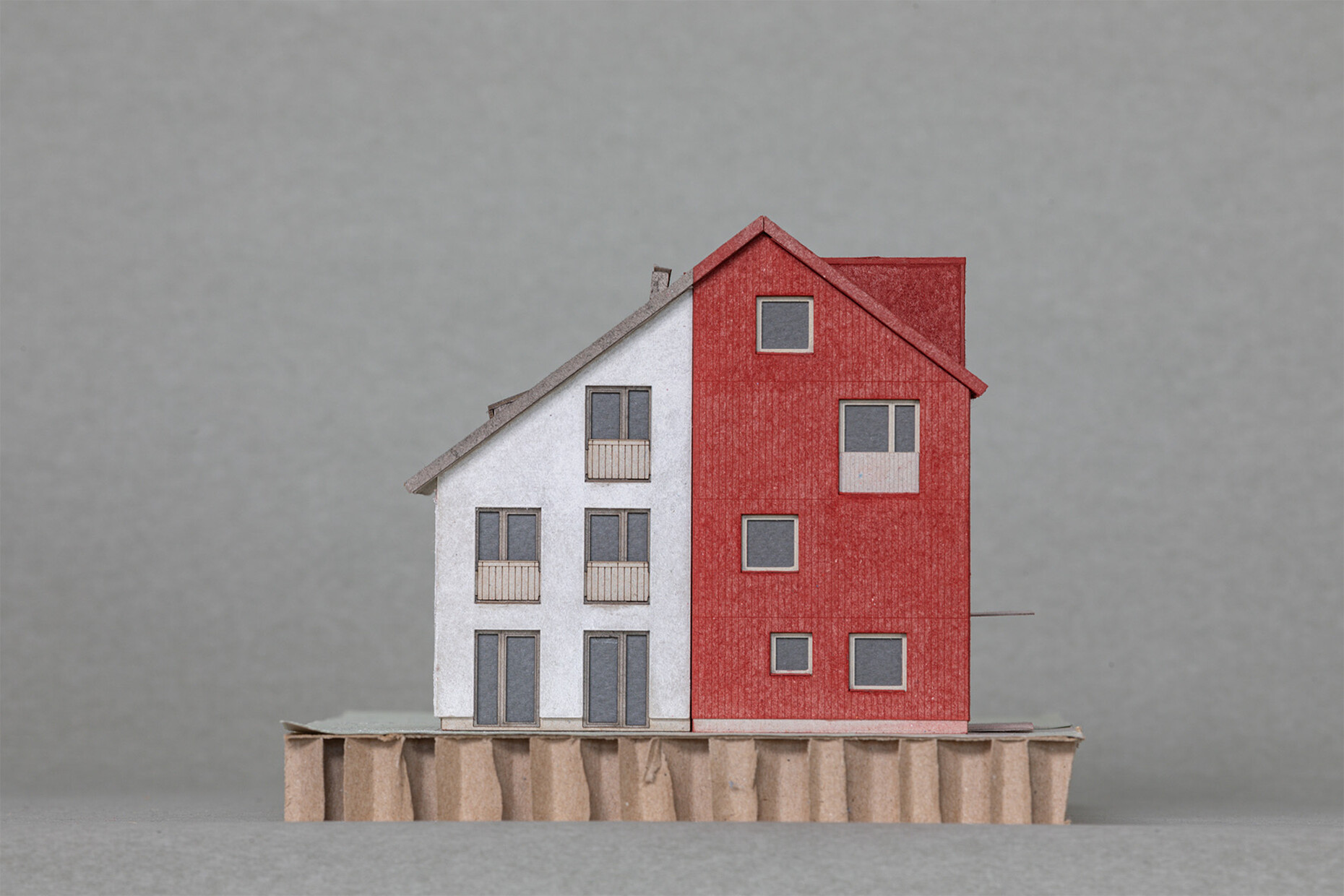
The DAM team organised the exhibition in collaboration with the Centre de Cultura Contemporània de Barcelona (CCCB), the our.house research cluster at the Technical University of Munich (TUM), and the ‘Living+/Exhibiting’ research group at the Marianne Steegmann Institute for Art and Gender in Bremen. As well as highlighting the downsides of the single-family home concept, the curators also emphasise its potential for the present and future. For instance, students from the Chair of Design, Renovation and Conservation at the Technical University of Munich have created models of existing single-family homes to demonstrate how this housing form could be used more efficiently by extending existing buildings.
At the same time, transformation projects such as 'Le Bonus Südtirol' are being presented. According to Valerie Kronauer, a research assistant at TUM, there, additional floor space can be obtained as an energy bonus for the energy-efficient renovation of existing buildings. She notes that 16 million of Germany's approximately 19 million residential buildings are detached houses. In the context of the climate crisis and housing shortages, the detached house is a type of existing building with considerable potential. There is no need to overhaul the fundamental concepts: specifically, converting homes could utilise existing space more effectively and integrate tenants into the property ownership structure. According to a TUM calculation, this approach could create over 90,000 new residential units in the Frankfurt metropolitan area.
Suburbia
Dreams of Home Ownership – Ways Out of the Housing Crisis
21 March to 18 October 2026
Deutsches Architekturmuseum (DAM)
Schaumainkai 43, 60596 Frankfurt am Main
Phone: +49 (0)69 212 388 44
Opening hours
Tue, Thu–Sun 11 am–6 pm
Wed 11 am to 8 pm
Closed on Mondays
Open on all public holidays from 11 am to 6 pm
There is an extensive programme of events to accompany the exhibition, including lectures, workshops and guided tours.